LLM Optimization Agency & Services for Reliable, Cost-Efficient, Enterprise AI Systems

HakunaMatataTech is an LLM optimization agency helping enterprises turn experimental large language models into stable, high-performance production systems. With 20+ years of engineering experience and 600+ projects delivered, we optimize LLMs for latency, accuracy, cost, and reliability across real business workflows. Our focus is not model demos. We design optimized inference pipelines, retrieval architectures, and evaluation systems that work at scale.

Industry leaders trust us

Lower Latency | Higher Accuracy | Controlled AI Costs at Scale

Why LLM Performance Degrades on Enterprise Use Cases

General-purpose LLMs perform well on broad tasks but enterprise use cases demand precision that general-purpose training does not provide. A model that performs well on generic document summarisation may produce unreliable outputs when applied to freight customs documentation, financial audit reports, or software requirement specifications — domains where terminology, format, and reasoning patterns differ significantly from general usage. Beyond domain accuracy, enterprise deployments expose two performance dimensions rarely tested in pilots: consistency and cost. A model that returns accurate outputs on average but varies significantly across similar inputs creates audit and compliance risks in regulated workflows. A model architecture that performs well at low request volumes may have inference costs that make production-scale deployment economically unviable. Fine-tuning addresses domain accuracy but introduces new risks — catastrophic forgetting, overfitting to training samples, and degraded performance on out-of-distribution queries. RAG architectures address knowledge currency and cost but require retrieval quality engineering that most teams underestimate. Without structured optimisation methodology, LLM performance plateaus early and the gap between what the model can do and what the enterprise use case requires remains unresolved.

How We Approach LLM Optimisation Systematically

LLM optimisation begins with defining the evaluation framework before making any changes to the model or prompts. Baseline performance metrics are established across the actual query distribution the system will encounter in production — not curated examples — covering accuracy, consistency, latency, and cost per query. With a measurement baseline in place, the optimisation strategy is selected based on the performance gap: fine-tuning for domain vocabulary and reasoning patterns, RAG architecture for knowledge currency and cost control, prompt engineering for output format and instruction-following, or a hybrid approach when use case requirements span multiple dimensions. Fine-tuning engagements include contamination analysis of training data, evaluation on held-out query distributions, and regression testing to confirm that gains in the target domain have not degraded baseline capability. RAG architecture optimisation covers chunking strategy, embedding model selection, retrieval evaluation, and re-ranking where retrieval precision requirements are high. The output of each optimisation engagement is a documented performance profile — what the system achieves, under what query conditions, and where its reliability boundaries are.

LLM Optimisation Without Full Model Retraining

Most enterprise LLM performance gaps do not require retraining a model from scratch or replacing the base model. Fine-tuning on domain-specific data requires a fraction of the compute cost of pre-training and can be applied to open-source foundation models already deployed in the enterprise environment. RAG architecture improvements — better chunking, improved embedding models, re-ranking layers — often resolve retrieval accuracy issues without any model-level changes. Prompt engineering and output validation layers can be applied to existing model deployments without infrastructure changes. LLM optimisation engagements typically integrate with the model infrastructure already in place, whether that is a cloud provider-hosted model, a self-hosted open-source model, or an API-based deployment. For organisations with data residency requirements that prevent use of cloud-hosted models, the optimisation methodology applies equally to on-premise or private cloud model deployments.

Why Enterprises Choose HakunaMatataTech as their prefered agency for LLM Optimization?

Most LLM initiatives fail after launch due to high inference costs, slow response times, hallucinations, and lack of observability. Enterprises work with Hakuna Matata because we treat LLM optimization as system engineering, not prompt tweaking. We optimize models, infrastructure, data pipelines, and evaluation loops together to deliver predictable, measurable outcomes.

1
End-to-End LLM System Optimization
We optimize across the full stack: model selection, prompt structure, token usage, retrieval layers, inference infrastructure, and caching strategies to balance performance, accuracy, and cost.
2
Latency and Throughput Engineering
We reduce response times using techniques such as prompt compression, batching, streaming responses, model routing, and GPU-aware deployment strategies for high-traffic applications.
3
Hallucination Reduction and Output Control
We implement Retrieval-Augmented Generation (RAG), guardrails, structured outputs, and confidence scoring to minimize hallucinations and ensure responses align with enterprise data and policies.
4
Enterprise Observability and Governance
We implement logging, evaluation metrics, versioning, and audit trails to monitor LLM behavior, cost usage, and quality drift over time, critical for regulated and large-scale environments.
What We Build

Our LLM Optimization Services for Enterprises & SMB's

Model and Inference Optimization

We evaluate and optimize models such as GPT-4/4o, Claude, LLaMA, and Mistral, selecting the right model per task and tuning inference parameters to reduce token usage and runtime cost.

Prompt Engineering and Prompt Compression

We redesign prompts for clarity, consistency, and minimal token usage, using structured prompts, templates, and dynamic context injection to improve response quality and reduce costs.

RAG Architecture and Vector Optimization

We design and optimize RAG pipelines using vector databases like Pinecone, Weaviate, or FAISS, improving retrieval relevance, reducing context size, and increasing factual accuracy.

Latency, Cost, and Scaling Optimization

We implement caching, request batching, model routing, and autoscaling strategies across cloud environments (AWS, Azure, GCP) to handle production traffic efficiently.

LLM Evaluation and Quality Metrics

We set up automated evaluation pipelines using test datasets, human-in-the-loop reviews, and scoring metrics to measure accuracy, relevance, and consistency over time.

Production Monitoring and Continuous Improvement

We implement real-time dashboards, alerting systems, and performance tracking to monitor LLM behaviour in production — detecting accuracy drift, latency spikes, cost anomalies, and quality degradation so teams can respond quickly and maintain reliable AI operations at scale.
Approach

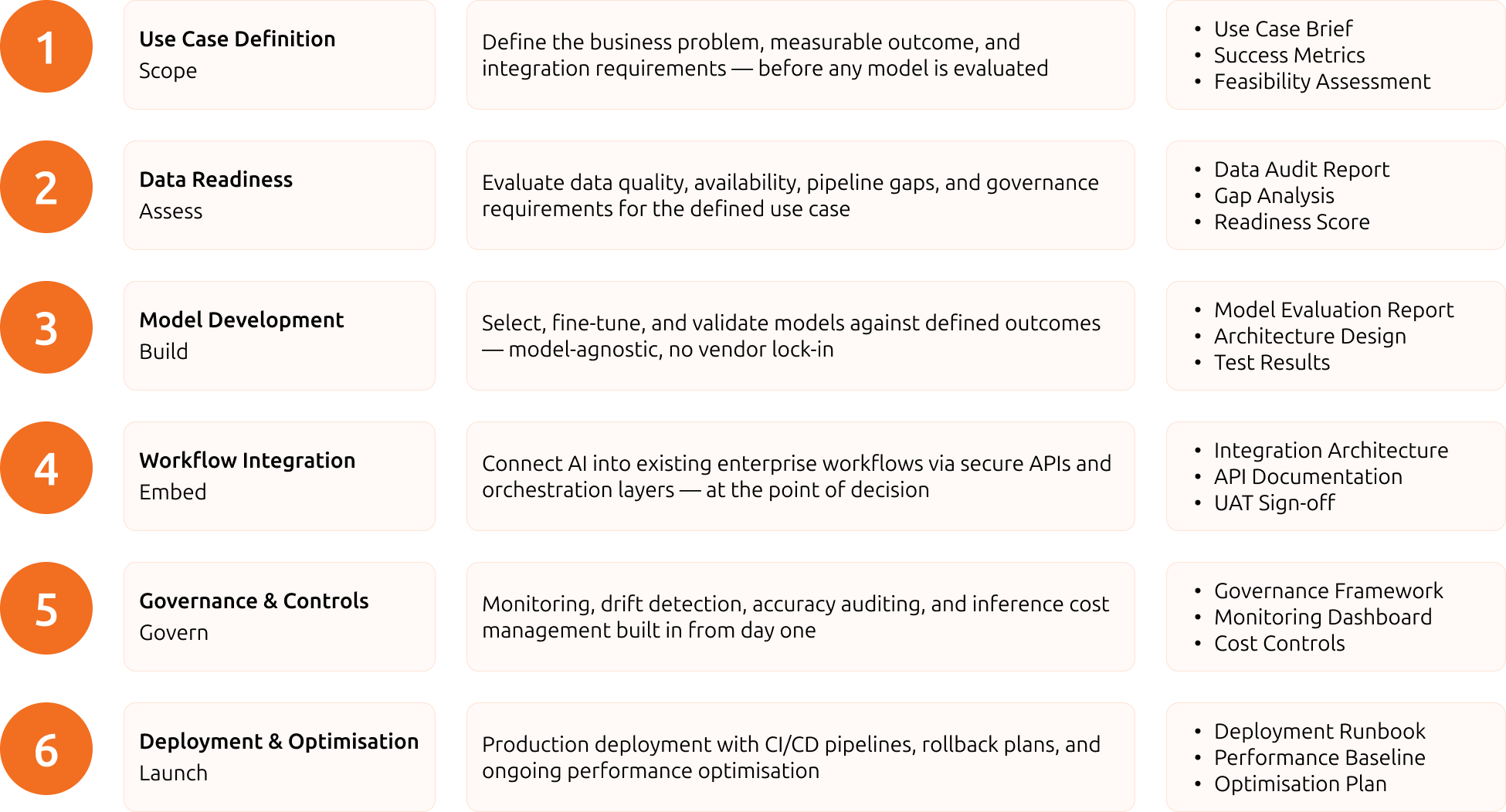
6 Pillars Of Development

We leverage cutting-edge tools to ensure every solution is efficient, scalable, and tailored to your needs. From development to deployment, our technology toolkit delivers results that matter.

Tech Differentiator
Go Live in Weeks—Not Months

We leverage proprietary accelerators at every stage of development, enabling faster delivery cycles and reducing time-to-market. Launch scalable, high-performance solutions in weeks, not months.

Reduce Dependencies on Third-Party Providers
Eliminate concerns over data leaks and escalating SaaS costs. At HMS, we deliver tailored open-source solutions designed for enhanced security and efficiency.
Crunch Dev Timeline
We have our proprietary tools/libraries to get MVPs in 6 weeks.
Models
Engagement Models We Use

Co-Engineering PODs

Partner with our cross-functional teams to accelerate delivery and ensure seamless integration with your modernization process.

End to End Modernization Ownership

Delegate the entire modernization journey to us—from strategy to deployment—while you stay focused on business growth.

Project-Based Model

Leverage our expertise for specific projects or phases, delivering tailored modernization solutions within defined timelines.

Frequently Asked Questions

What is LLM optimization?

LLM optimization improves the performance, cost efficiency, and reliability of large language model deployments — through prompt engineering, fine-tuning, model compression, caching strategies, and output evaluation frameworks that ensure consistent, accurate responses.

When should you fine-tune an LLM versus using prompt engineering?

Prompt engineering is faster and sufficient for most use cases. Fine-tuning is appropriate when the model consistently fails to follow a specific output format, lacks domain-specific knowledge not in the base model, or needs to behave in ways not achievable through prompting alone.

How do you reduce LLM inference costs in production?

Cost reduction strategies include prompt compression, caching repeated queries, using smaller models for simpler tasks, batching requests, and routing logic that sends only complex queries to premium models. HMT audits production LLM usage and implements the most cost-effective configuration.

How do you evaluate LLM output quality?

HMT builds evaluation frameworks that measure factual accuracy, response relevance, format compliance, and toxicity — using automated metrics, reference datasets, and human review. Evaluation runs continuously in production to catch model drift or degraded output.

Can you optimize LLMs that are already in production?

Yes. HMT audits existing LLM deployments — reviewing prompt design, model selection, retrieval quality, latency, and cost — then implements targeted improvements. Most production LLM systems have significant optimization headroom without requiring re-architecture.

Testimonials

Foreword by our clients

Strong Technical Knowledge
Clients commended Hakuna Matata for their strong technical expertise, particularly in technologies like Electron, AngularJS, Node.js, and HTML5. Their ability to solve technical problems and provide robust solutions was a recurring theme.
Quick and Reliable Support
Clients applauded Hakuna Matata’s responsiveness and adaptability, ensuring timely solutions and unwavering support throughout the project lifecycle.
Driving Business Growth
Hakuna Matata’s solutions delivered real business value, streamlining operations, cutting costs, and boosting productivity for long-term growth.
Clear and Transparent Communication
Hakuna Matata’s proactive and transparent communication kept clients informed, built trust, and ensured seamless collaboration—even during challenges.
Innovative Problem Solvers
Hakuna Matata’s ability to tackle complex challenges—from custom algorithms to multi-platform solutions—set them apart as trusted innovators.
Built on Trust and Success
Hakuna Matata’s long-term client relationships reflect their consistent delivery, reliability, and ability to evolve alongside business needs.
Strong Technical Knowledge
Clients commended Hakuna Matata for their strong technical expertise, particularly in technologies like Electron, AngularJS, Node.js, and HTML5. Their ability to solve technical problems and provide robust solutions was a recurring theme.
Quick and Reliable Support
Clients applauded Hakuna Matata’s responsiveness and adaptability, ensuring timely solutions and unwavering support throughout the project lifecycle.
Driving Business Growth
Hakuna Matata’s solutions delivered real business value, streamlining operations, cutting costs, and boosting productivity for long-term growth.
Clear and Transparent Communication
Hakuna Matata’s proactive and transparent communication kept clients informed, built trust, and ensured seamless collaboration—even during challenges.
Innovative Problem Solvers
Hakuna Matata’s ability to tackle complex challenges—from custom algorithms to multi-platform solutions—set them apart as trusted innovators.
Chief Digital Officer,
Maersk Training
Hakuna Matata excels in adaptability, technical expertise, and seamless integration of complex systems.
Nikhil Goel
VP & Head IT - Projects,
Max Healthcare
Niral.AI transformed our front-end development. Their expertise boosted efficiency and cut costs
VENKAT RAMAKANNAIAN
Facility Manager, Caterpillar
"The team is young and enthusiastic and are eager to provide solutions to the complex tasks with ease. Nice team to work with. Look forward to work for more projects."
ROBERTO BADÔ
Chief Technology Office at Photon Group
"Hakuna Matata Solutions always delivered exactly what we wanted"
JOE HUDICKA
Senior Solutions Architect The Clarity Team
"There is a real, true, personal interest their entire team shares in your success as a client"
Neeraj T
Executive Director - One Plug EV
Delivered charging management system and App on time with excellent UI/UX, handling critical protocols efficiently.
VENUGOPAL R
Manager of Design, Saint Gobain India Private Limited
"Hakuna Matata’s technical strength is their biggest plus point. Our experience with them has been very positive."
Nikhil Agrawal
Co-founder, LiftO
Hakuna Matata’s work has contributed a lot to our success.
JAYASANKAR S
Head Information Technology, Roca India
"The experience of working with hakuna matata has been excellent. Your team was responsive, and ably managed the project scope and our requirements & expectations."
LEIF MEITILBERG
Head of Group IT - Maersk Training
"The team at Hakuna Matata came up with the database design and we immediately realized how efficiently they have handled data. These guys know what needs to be done and how."
RAJESH LAKSHMANAN
Head IT, Sicagen
"We’ve been working together with Hakuna Matata Solutions for 3 years and they’ve helped resolve most complex of issues. Quality of work is high and I would highly recommend them."