
Agentic SDLC: How AI-Native Software Delivery Actually Works
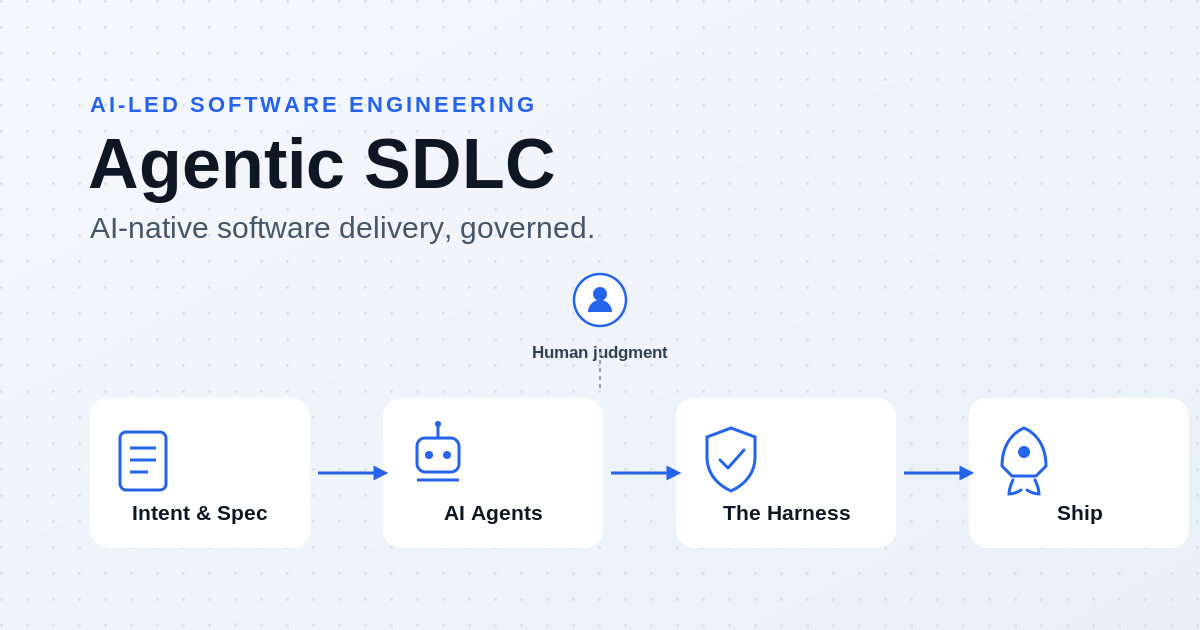
Most conversations about the agentic SDLC start in the wrong place. They start with the agent — which model, which framework, how many pull requests it can open unattended. That is the easy part, and it is largely solved. The hard part, the part that decides whether an agentic pilot becomes a production practice or a cancelled line item, is everything built around the agent: the specifications, the guardrails, the verification, and the shared context that keeps a fleet of agents consistent across an organization.
This guide is about that surrounding system. It is written for the VP of Engineering or CTO who has seen the demos, watched an agent refactor a module in one shot, and now has to answer a harder question: what actually has to change in how we build software before we can trust this at scale?
What the Agentic SDLC Actually Is
The agentic software development lifecycle is a delivery model in which autonomous AI agents carry out multi-step lifecycle work, from planning and coding through testing and review, while humans set the intent, design the constraints, and approve what ships. It is a step beyond AI-assisted development, and the distinction matters.
In AI-assisted development, a human drives every step and the AI fills gaps: inline autocomplete, a suggested function, a chat fix. The engineer is still doing the work. In the agentic SDLC, an agent takes a macro-goal such as a ticket or an acceptance spec, reasons across multiple files, runs its own test cycles, self-corrects on failure, and opens a pull request for review. The human moves from writing lines to defining outcomes and judging results.
Across the teams and vendors defining this space in 2026, a consistent four-layer picture has emerged:
- Intent and specification. Humans define architectural constraints, acceptance criteria, and objectives through structured specifications rather than casual prompts. Precision here is what makes autonomous work reviewable.
- The harness. The constraint system that governs agents in real time — linters, test suites, security gates, and policy engines that bound what an agent may do and catch what it gets wrong.
- Continuous verification. Automated quality gates that evaluate correctness, security, and logic drift at the speed agents generate code.
- Human judgment. Engineers own system architecture, complex trade-offs, final review, and any high-risk override.
Notice where the work concentrates. Three of the four layers are not about the agent at all. They are about governing it. And that is exactly where most organizations are underinvested.
Why Most Agentic-SDLC Pilots Stall
The adoption numbers look like a landslide. By some estimates around 80% of enterprise applications shipped or updated in early 2026 embedded at least one AI agent, and Gartner projects that more than 40% of enterprise applications will include task-specific agents by the end of 2026, up from under 5% a year earlier. Getting an agent to write code is no longer the constraint.
Shipping it safely is. The same period produced a second, quieter set of numbers. Veracode's 2026 GenAI Code Security Report, which tested more than 100 large language models, found that 45% of AI-generated code samples introduced an OWASP Top 10 security vulnerability — and the average security pass rate has stalled near 56%, even as AI now writes roughly half of all committed code. New Relic's 2026 State of AI Coding report surfaced the more revealing contradiction: 94% of technology leaders rated AI-generated code as higher quality than human-written code at review time, yet 78% reported more production incidents once it shipped, and 74% said at least a quarter of their AI-generated code needed significant rework. Sonar's research adds the reason it slips through — nearly half of developers do not review AI-generated code at all.
The failure mode here is not obvious breakage. It is the illusion of correctness: code that looks polished, reads plausibly, and passes a casual glance while concealing an over-permissive access rule or an unvalidated input. Agents produce that kind of code faster than a team without a harness can catch it — which is exactly why the code that grades well in review still triggers incidents in production.
This is why the projects fail rather than the pilots. Gartner expects more than 40% of agentic AI projects to be cancelled by the end of 2027, citing unclear value, cost, and inadequate risk controls. An agent that generates plausible code in a demo is a proof of concept. An agent whose every action is specified, bounded, verified, and logged is a production capability. The gap between those two is the harness, and building it is an engineering project in its own right.
The Consistency Problem: From Per-Project Prompts to Organization-Wide Context
There is a second failure that shows up only at scale, and it is the one least discussed in the current literature. One agent, well-supervised, on one project, works. The trouble starts at the fifth agent, the third team, the second business unit — when every agent is operating from its own copy of "how we build here."
Prompts and context assembled per project do not compose. Team A's agent learns the payments domain one way; Team B's agent never sees it. A hard-won architectural decision lives in one senior engineer's head and one Slack thread. When agents draw on fragmented, private context, they drift apart — and the organization ends up with autonomous systems that are individually competent and collectively inconsistent.
The mechanism that fixes this is organization-wide contextual memory: a shared, governed layer that captures what agents and engineers actually need to reason from (architecture decisions, data lineage, domain rules, past incidents, and the reasoning behind them) and makes it queryable. When that context is shared and standardized rather than trapped in individuals or single projects, three things change. A policy or standard updates once, centrally, and every agent reflects it. New agents and new teams start from what the organization already knows instead of relearning it. And the review burden drops, because agents are working from the same source of truth a reviewer would check against.
This is the difference between deploying agents and building an AI-native engineering organization. The first is a tooling decision. The second is an operating-model decision, and contextual memory plus a standardized process is what makes it repeatable rather than heroic.
Governance and Verification at Agent Speed
If the harness is the answer, what is actually in it? For enterprise engineering leaders, four controls do most of the work.
Specification as a gate, not a suggestion. Agents act on what they are told. Vague intent produces confident, wrong output. Structured acceptance criteria (what "done" means, what must not change, which systems are off-limits) are the first line of governance, and they are a human responsibility.
Verification that runs at generation speed. Manual review cannot keep pace with an agent that opens twenty pull requests before lunch. Automated quality gates (test coverage thresholds, security scanning, static analysis, regression checks) have to sit in the pipeline and block on failure, not advise after the fact.
Action-level permissions and audit trails. An agent should have autonomous authority only within clearly defined bounds; outside them, it flags and routes to a human. Every action it takes needs a queryable record. Enterprise security and legal reviews will ask for that log before an agent touches a production system, and deployments that cannot produce it do not pass.
A human core team on the seams. The most reliable agentic setups keep senior engineers where judgment is irreplaceable: system architecture, cross-cutting trade-offs, final review of anything high-risk. The agent accelerates the work; it does not remove the accountable human.
None of this is exotic. It is disciplined engineering applied to a new kind of contributor. The organizations that build these controls before scaling agents spend far less time retrofitting them after an incident than the ones that ship first and govern later.
What Actually Changes for Engineering Leaders
Adopting the agentic SDLC is not a headcount-reduction exercise, and framing it that way is how pilots lose their sponsors. What changes is where engineering effort is spent.
Time shifts from writing code to specifying, reviewing, and governing it. The value of a senior engineer rises, because judgment, architecture, and the ability to design a good harness become the scarce inputs. Onboarding changes: a new engineer's leverage now depends partly on how good the organization's shared context is. And the metrics on the engineering dashboard change — leading teams are beginning to track AI-attributed regression rates, incident severity linked to agent-generated changes, and review-confidence scores alongside velocity.
The budget conversation changes too. The cost of an agentic capability is not the model subscription. It is the harness, the verification infrastructure, the contextual-memory layer, and the senior time to run them. Priced honestly, the payback is still compelling, with median time-to-value on agent deployments measured at roughly five months, but only when the surrounding system is funded rather than assumed.
AI-Accelerated Delivery, in Practice
The pattern above is not theoretical for us. When we modernized Max Healthcare's Hospital Information System, 17 modules and more than 1,000 screens migrated live with zero downtime, we ran exactly this split. A human core team rebuilt business logic for clinical accuracy, while an extension team used our Niral.ai accelerator to convert Figma designs directly into production Angular code.
The point is not that the AI wrote code. The point is what the harness around it produced: a 150% increase in screens delivered per day, a 70% reduction in development effort, and 300 screens modernized and live in six months — with the accountable human team owning correctness. Max Healthcare's VP and Head of IT Projects, Nikhil Goel, put it plainly: "Thanks to Niral.ai, we achieved faster UI development, better component reusability, and reduced costs. Its AI-generated code is impressively close to Figma designs." AI-generated code, inside a governed pipeline, reviewed by people who own the outcome.
The same discipline applies beyond code generation. Our NunarIQ platform puts autonomous agents into document- and message-driven back-office workflows (reading email, PDFs, and spreadsheets, then extracting, validating, and updating enterprise systems) and cuts up to 80% of manual tasks while running under role-based access and on-premise or private-cloud controls. Agents doing real work, bounded by real governance. That is the shape of an agentic SDLC that survives contact with production.
Adopting the Agentic SDLC Without the Chaos
The organizations that get this right do not flip a switch. They sequence it.
Start with one high-volume, well-bounded workflow where the before-and-after is measurable and the blast radius is small. Build the harness for that workflow first (the specs, the gates, the audit trail) and prove the agent can work inside it. Capture what you learn into shared context so the next team starts ahead, not level. Then expand, standardizing the process as you go rather than letting each team invent its own. Governance, verification, and contextual memory come before scale, not after the first production incident forces the issue.
Evaluating an AI-Led Engineering Partner
If you are bringing in help, the questions that separate a real partner from an AI-washing vendor are about the harness, not the agent:
- How do you specify and bound what an agent is allowed to do, and how is that enforced in the pipeline?
- What verification runs on agent-generated code before it merges, and what blocks a merge?
- How do you keep agents consistent across teams — what is your approach to shared context and standards?
- Where does the accountable human sit, and what do they own?
- Can you show a real engagement with verified outcomes, not a demo?
A partner who answers those with mechanisms and evidence is describing an agentic SDLC. A partner who answers with model names is describing a tool. For a deeper look at how we build and govern these systems, see our approach to AI-led software engineering and enterprise AI solutions, what actually separates a credible AI agent development company from the pack, and what CTOs get wrong about enterprise AI agent development.
The agentic SDLC is not the future of a few frontier teams; the adoption curve says it is arriving across the enterprise now. But the teams that win with it will not be the ones with the most autonomous agents. They will be the ones with the best harness — the specifications, the verification, and the shared context that turn fast, plausible code into software you can actually ship.
