
Custom Energy Management Software Development for Enterprises
Custom Energy Management Software Development | TL; DR
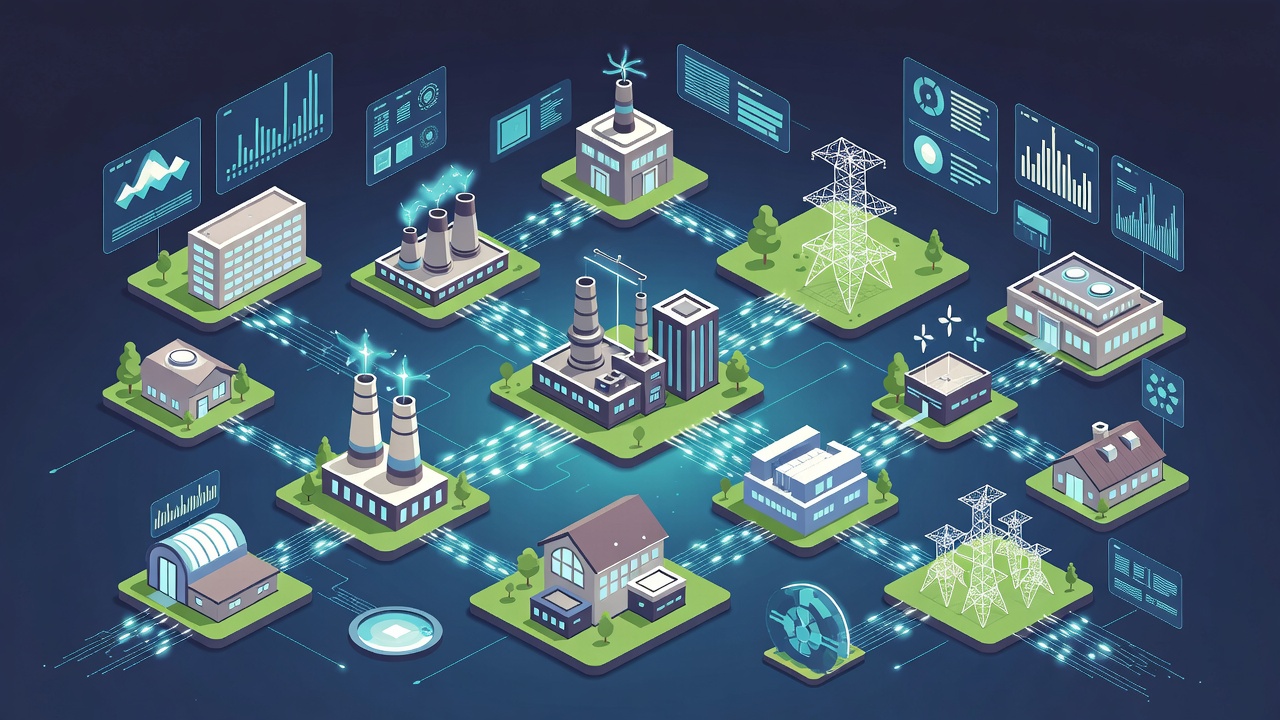
Custom energy management software (EMS) development involves creating a tailored digital ecosystem to monitor, control, and optimize energy consumption across various assets.
Custom energy management software development tailors a data-driven platform to your specific assets, operational goals, and local utility landscape, delivering higher ROI than off-the-shelf solutions by addressing your unique energy challenges.
In 2026, these solutions are increasingly prioritized to manage volatile energy prices, integrate renewable sources, and meet stringent ESG (Environmental, Social, and Governance) reporting standards.
Core Capabilities of Custom EMS
Modern custom solutions move beyond simple monitoring to provide proactive intelligence:
- Real-Time Monitoring: Continuous data ingestion from smart meters, IoT sensors, and SCADA systems.
- AI-Driven Analytics: Predictive modeling for demand forecasting, anomaly detection to identify leaks or equipment failures, and automated load balancing.
- Renewable Integration: Specialized modules for managing solar, wind, and battery storage systems (BESS), including IEEE 2030.5 protocol implementation for grid interoperability.
- Compliance & Reporting: Automated generation of audit-ready reports for ISO 50001 standards and carbon footprint tracking.
Development Process & Costs
Building a custom EMS typically follows an agile lifecycle:
- Requirements & Audit (1-2 months): Mapping operational workflows and existing infrastructure.
- MVP Development (3-6 months): Creating a Minimum Viable Product focusing on core monitoring and visualization.
- Full-Scale Implementation (6-12+ months): Integrating advanced AI, multi-site rollouts, and legacy system synchronization.
Estimated Costs (2026):
- Entry-Level AI Solutions: Starting from $20,000 for basic monitoring and 2-3 months of development.
- Enterprise Systems: Range from $50,000 to $200,000+ depending on complexity, such as predictive maintenance or complex grid integrations.
Key Market Players for Development
Several specialized firms offer end-to-end development services:
- Albiorix Technology: Focuses on smart city software, street light management, and energy trading portals.
- Chetu: Provides custom utility asset management, solar software development, and AI-powered cybersecurity for energy grids.
- Innowise: Specializes in Digital Twins for power grids and blockchain-based renewable certificates.
- Lemberg Solutions: Expertise in battery management systems (BMS) and hardware-software integration for IoT-enabled devices.
Why Custom EMS Trumps Off-the-Shelf in 2026?
Most "ready-made" energy platforms are just glorified dashboards. They show you that you spent $50,000 on power last month, but they don't tell you why or how to stop it.
For US companies, the "why" often sits in the fine print of regional grid regulations.
The FERC Order 2222 Advantage
In 2026, the second set of tariff changes for FERC Order 2222 becomes effective. This allows small-scale distributed energy resources (DERs), like your rooftop solar or EV chargers, to participate in wholesale markets.
- Off-the-shelf software usually lacks the sub-metering logic to aggregate these assets.
- Custom software allows you to "bundle" your energy and sell it back to the grid, turning an expense into a revenue stream.
Integration with American Infrastructure
US facilities often run on a "Frankenstein" mix of hardware: Schneider Electric breakers, Honeywell HVAC systems, and Tesla Powerwalls.
Custom development uses API-first architectures to bridge these silos, creating a single "pane of glass" for your entire operation.
Cost of Custom Energy Management Software Development in America
Building software in the US is an investment. While you can outsource, many American firms prefer domestic development for security and compliance reasons.
Development Cost Breakdown (2026 Estimates)
Why Off-the-Shelf Energy Software Falls Short for Complex U.S. Operations?
Many American businesses start their search with commercial, subscription-based energy management systems.
These platforms offer a quick entry point. However, as your needs mature, their limitations become costly constraints.
The Integration Bottleneck
- Legacy machinery on a factory floor in Michigan doesn't speak the same language as a new chiller system in a Phoenix data center.
- Off-the-shelf software typically relies on a set list of supported protocols and pre-built drivers.
- If your specific combination of PLCs, meters, and building management systems (BMS) isn't on that list, you face expensive and clunky workarounds.
- Custom software is built with your existing industrial IoT infrastructure in mind from day one.
- The development team creates adapters and normalizes data from all your sources, Modbus, BACnet, OPC-UA, proprietary APIs, into a single, coherent data model.
The "One-Tariff-Fits-All" Problem
- Energy costs in America are not uniform.
- The demand charges levied by a utility in Pennsylvania differ vastly from the time-of-use (TOU) rates in California or the real-time pricing in ERCOT (Texas).
- A generic platform might show you consumption, but it cannot natively model your specific, complex utility contracts to provide accurate cost forecasts or prescriptive "cost avoidance" alerts.
- Custom software embeds your actual tariff structures, enabling true financial intelligence.
- For a client in the PJM Interconnection market, we built a feature that simulates the financial impact of load-shifting decisions against real-time locational marginal pricing (LMP), a level of specificity no generic tool could offer.
Lack of Process-Specific Intelligence
- A plastic injection molding plant and a large-scale bakery both use a lot of energy, but their waste patterns are completely different.
- A generic dashboard might flag "high energy use at 10 AM."
- A custom system, built with operator input, knows that the spike corresponds to the simultaneous start-up of three extruders and can recommend a staggered start sequence.
- It moves from monitoring to providing actionable energy insights tied directly to your standard operating procedures (SOPs).
The Scalability and Ownership Dilemma
- As your business grows, adding new facilities, acquiring companies, or expanding product lines, your software must evolve with you.
- With a SaaS product, you are often at the mercy of the vendor's roadmap and pricing tiers.
- Custom software gives you full ownership of the codebase and data.
- You control the roadmap, decide on integrations, and scale on your infrastructure.
- The initial investment transitions from an ongoing operational expense (OpEx) to a capitalized asset (CapEx) that you wholly control.
The Core Architecture of a Modern Custom EMS Platform
Building a robust Energy Management System (EMS) is not about creating a single monolithic application. It's about constructing a flexible, data-centric architecture.
Based on our projects for American clients, here is the proven stack and flow.
1. The Data Acquisition & Ingestion Layer
This is the foundation. The system must connect to all energy data sources:
- Smart Meters & Sub-meters: Pulling interval data (15-minute, 5-minute) via protocols like Modbus or utility APIs like Green Button Connect.
- Building Management Systems (BMS): Integrating with systems from Siemens, Johnson Controls, or Honeywell to get HVAC, lighting, and equipment runtime data.
- Industrial IoT Sensors: Streaming data from vibration, temperature, pressure, and flow sensors on production lines.
- Weather Data APIs: Ingesting local forecasts and historical data from sources like NOAA or OpenWeatherMap to correlate weather with energy use.
- Utility & Market Data: Connecting to ISO/RTO portals (like CAISO or NYISO) for grid status and pricing signals.
A custom solution uses a scalable message broker (like Apache Kafka or MQTT) to handle this high-volume, high-velocity data stream reliably.
2. The Data Processing & Normalization Engine
Raw data is messy. This layer, often built using cloud services like AWS IoT Core or Azure Digital Twins, cleanses, tags, and contextualizes the data.
- It converts all units to a standard (e.g., all power to kW, all gas to BTU).
- It tags each data stream with metadata (e.g.,
Facility: Plant_B, Circuit: Compressor_Line_3, Cost_Center: Production_Department). - It performs energy data analytics basics: calculating baselines, detecting outliers, and aggregating data for different views (by shift, by product line, by square footage).
3. The Analytics & Intelligence Core
This is where the software transitions from a data historian to an intelligent advisor.
We implement:
- Machine Learning Models: To predict energy load based on production schedules, weather, and historical patterns. This allows for precise demand response participation.
- Fault Detection & Diagnostics (FDD): Rule-based and AI-driven algorithms that spot inefficiencies, like a simultaneous heating and cooling conflict or a failing pump bearing, before they cause waste or downtime.
- Custom Optimization Algorithms: These are the secret sauce. For a cold storage logistics company, we developed an algorithm that optimizes compressor runtimes against both TOU rates and internal product temperature requirements, guaranteeing quality while minimizing cost.
4. The User Interface & Action Framework
The intelligence is useless if it doesn't lead to action.
The UI must be role-specific:
- Operator View: Simple, alarm-driven screens on tablets or shop-floor monitors showing clear instructions ("Delay Batch #405 start until 2 PM to avoid peak demand charge").
- Energy Manager View: Dashboards with drill-down capabilities, savings tracking, and reporting tools for utility bill validation.
- Executive View: High-level KPIs, sustainability metrics (carbon footprint), and financial savings summaries.
The system must also have an action framework, automated controls (where safe and approved) or structured work orders that integrate with systems like IBM Maximo or ServiceNow to close the loop from insight to repair.
Key Features That Deliver Tangible ROI for American Businesses
When you invest in custom software, you pay for features that solve your specific problems.
Here are the high-impact capabilities our U.S. clients consistently value most.
Granular Utility Bill Management & Cost Allocation
- Beyond just displaying a bill, a custom EMS can automatically parse complex utility invoices from providers like Con Edison or Pacific Gas and Electric, validate charges against meter data, and catch errors.
- It can then allocate costs down to the department, cost center, or even individual production lines with precision, turning energy from an overhead cost into a direct operational variable.
Predictive Maintenance Driven by Energy Signatures
- Equipment failure often shows early warning signs in its energy consumption pattern (its "signature").
- A custom platform can learn the normal energy signature of a critical asset, like a large industrial fan or a process chiller, and alert maintenance teams to deviations weeks before a temperature or vibration sensor would trigger an alarm.
- This shift from reactive to predictive maintenance avoids costly unplanned downtime and inefficient "running-to-failure" energy waste.
Automated Demand Response & Grid Service Participation
- For companies in regions with strong incentive programs, this is a revenue center.
- Custom software can be programmed to understand your facility's unique flexibility.
- It can automatically shed or shift non-critical loads in response to a grid signal from CPower or Enel X, ensuring you capture demand response payments without disrupting core operations.
- We implemented this for a water treatment plant in the Midwest, allowing them to participate in MISO markets safely and profitably.
Sustainability Reporting & Carbon Accounting
- With increasing pressure from investors, customers, and regulations, automated ESG reporting is no longer a nice-to-have.
- A custom system can automatically calculate Scope 1 and Scope 2 greenhouse gas emissions based on energy consumption data and emission factors from the EPA's eGRID.
It generates audit-ready reports for frameworks like GHG Protocol or CDP, turning a manual, quarterly burden into a continuous, accurate stream of data.
Comparison Table: Custom vs. Off-the-Shelf vs. Basic BMS
Implementation Strategy: The 4-Step Roadmap
If you want to move from high utility bills to energy independence, follow this framework:
Step 1: The "Digital Twin" Discovery
We start by mapping every physical asset in your facility. We don't just look at meters; we look at the physics of your energy flow. This allows us to build a "digital twin" of your operation to test energy-saving scenarios without risking your actual equipment.
Step 2: Protocol Orchestration
US industrial sites often use Modbus, BACnet, or Zigbee protocols. We build a custom middleware layer that translates these different "languages" into a single, clean data stream. This is where most off-the-shelf products fail.
Step 3: AI Model Training
We feed the system 3–6 months of your historical data. We train the AI to recognize your specific "energy signature", like the exact moment your CNC machines power up or your HVAC kicks in. This allows for hyper-accurate forecasting.
Step 4: Regulatory Compliance Integration
Finally, we bake local utility rules into the code. If your provider in California offers a "Demand Response" program, the software knows exactly when to throttle usage to maximize your rebates.
The ROI of Custom Development
Energy is no longer just a fixed cost; it is a strategic asset. By 2026, the gap between companies using intelligent, custom software and those using manual spreadsheets will be a chasm. A custom EMS doesn't just "save electricity", it protects your hardware, automates your compliance, and even generates revenue through grid participation.
