
Real-Time Supply Chain Visibility for Enterprise: How IoT Data Powers Logistics Decision-Making
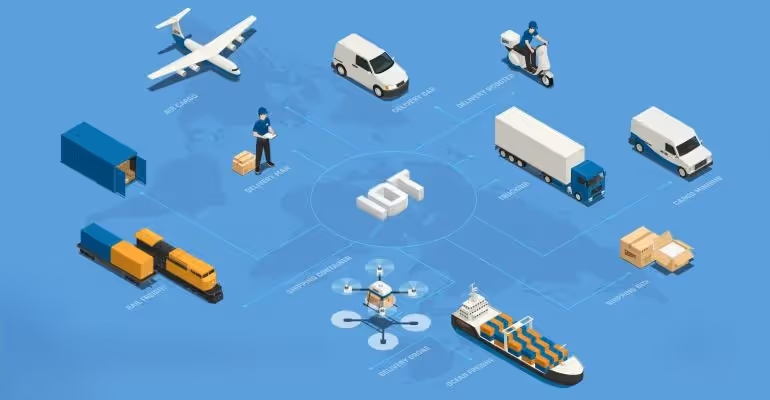
A shipment leaves your distribution centre. Your ERP records the departure. From that point until it hits a customer dock, your visibility depends on carrier status updates that arrive when carriers choose to send them, which is not the same as when you need them. Disruptions compound in that gap. A temperature excursion in a reefer unit, a container sitting in a port queue three days past its dwell limit, a truck two hours behind schedule for a time-sensitive delivery window: none of these are visible until they are already a problem.
End-to-end visibility is now the top investment priority for global supply chain professionals, according to Gartner 2025 research. The technology to deliver it exists. IoT sensors on vehicles, containers, and warehouse environments generate continuous data on location, condition, and status. The challenge for Supply Chain IT heads and VP Logistics is not finding sensors. It is getting sensor data into a form that produces decisions rather than raw readings. A visibility platform that surfaces 200 alerts per day without prioritising or contextualising them creates more work, not less.
You cannot manage what you cannot see, and for most large organisations, significant stretches of the supply chain remain invisible. Purchase orders leave the ERP and enter a black box of carriers, forwarders, ports, and third-party logistics providers. Shipments are late before anyone knows to act. Disruptions compound because the first signal arrives too slowly. This post covers how enterprise logistics teams are building IoT visibility that produces actionable intelligence, the specific use cases where IoT data delivers documented ROI, and what the integration architecture actually requires. For IoT visibility extended into yard and dock operations, the yard management system post covers the last gap in the shipment visibility chain.
Why Most Enterprise Visibility Deployments Underdeliver
Mid-size logistics companies typically run four to seven disconnected systems: a legacy TMS, a WMS last updated years ago, carrier portals with no shared APIs, and a spreadsheet-based exception management process that one person maintains. Getting supply chain visibility software to work across all of these is not a configuration task. It is an integration architecture project.
The gap between IoT sensor data and useful visibility is the integration layer. A GPS tracker on a vehicle records position every 30 seconds. That data is useful when it flows into a system that also knows the delivery schedule, the traffic conditions on the route, and the customer's delivery window, and can surface a predicted late arrival four hours before it happens rather than after the customer calls. Most enterprise logistics operations have sensors. Fewer have the integration architecture that makes sensor data actionable.
Companies that handle this well start with a data layer strategy before picking a visibility platform. Centralising data sources early reduces integration complexity by 40 to 60% compared to point-to-point connections and makes the analytics layer far more reliable when you add it later.
The business case for getting this right is clear. McKinsey documents 15% cost savings from real-time IoT tracking in logistics operations. Companies investing in supply chain visibility report 20% improvement in on-time delivery performance and significant reductions in exception management labour costs. The ROI is there. The question is whether the integration architecture supports it.
The Five IoT Use Cases With Documented Enterprise Value
1. In-Transit Shipment Tracking and Predictive ETA
Real-time shipment tracking connects GPS devices on vehicles and containers to a visibility layer that calculates current ETAs based on actual position and conditions, not planned schedules. The difference between a planned ETA and an AI-calculated ETA based on current traffic, road conditions, and historical carrier performance is where the value sits.
project44's Movement platform, used by large enterprise shippers across retail, manufacturing, and life sciences, provides real-time tracking, predictive ETA calculations, and AI-powered exception management that surfaces disruptions before they affect customers. The platform spans more than 1.5 billion shipments and 7.3 trillion data points. That scale of carrier connectivity is what makes predictive ETA calculations reliable for the long tail of carriers in a typical enterprise routing guide.
For the Supply Chain IT team, the integration requirement is connecting the visibility platform to your TMS for delivery schedule data and your order management system for customer commitment data. The alert logic needs to know which shipments matter most, not just which shipments are running late.
2. Cold Chain Monitoring and Compliance
Cold chain IoT monitoring is the use case with the most direct regulatory dimension. For pharmaceutical, life sciences, and food distributors, FDA regulations under 21 CFR Part 211 and GDP guidelines require continuous temperature monitoring with documented audit trails, defined alert response procedures, and data retention for the product shelf life plus one year.
A pharmaceutical distributor managing cold chain across 12 distribution centres was carrying $4.2 million in annual product loss from temperature excursions, most of which were discovered during receiving inspection rather than during transit. The root cause was that temperature monitoring at the DC level was continuous, but monitoring in transit relied on manual logger downloads at delivery points.
The visibility system they built deployed Bluetooth-enabled temperature and humidity sensors in reefer units, connected through cellular gateways to a cloud monitoring platform. The platform monitored temperature, humidity, and door-open events continuously, with configurable alert thresholds and escalation workflows tied to their excursion response SOPs. FDA-required data was automatically archived with chain of custody documentation. Product loss from temperature excursions fell 67% in the first year. The audit preparation time for FDA inspections dropped from three weeks to two days because all required data was queryable from a single system.
The compliance layer is where cold chain IoT deployments for pharma and food logistics require specific design attention. Alert response workflows need to be documented and enforced, not just configured. A platform that sends an alert and has no record of whether the alert was acknowledged and what action was taken does not satisfy GDP audit requirements.
3. Fleet and Vehicle Performance Monitoring
IoT sensors on fleet vehicles generate engine diagnostics, fuel consumption, driver behaviour data, and maintenance indicators that predictive maintenance models use to schedule service before failures occur. Gartner documents 20 to 30% maintenance cost reduction from predictive maintenance programmes in commercial fleets, with downtime dropping from 15 to 20 days per vehicle per year to 2 to 4 days.
The fleet management integration connects vehicle telematics to the maintenance management system to trigger work orders automatically when diagnostic thresholds are crossed. The data also feeds route optimisation models: a vehicle flagged for upcoming maintenance on a specific axle should not be assigned to the heaviest loads until that service is complete.
For enterprise fleets running mixed OEM telematics, the integration challenge is normalising diagnostic data from different vehicle makes and models into a consistent format. Most enterprise fleets are not a single OEM, and the data protocols differ between manufacturers. The middleware layer that normalises this data is not glamorous engineering work, but it is where the maintenance prediction model gets the consistent input it needs to perform reliably.
4. Cargo Condition and Security Monitoring
Beyond temperature, IoT cargo monitoring covers humidity, shock and vibration, light exposure (indicating unauthorised container access), and GPS position for high-value or high-risk freight. Overhaul, which raised a $105 million Series C in August 2025, combines real-time monitoring, predictive risk intelligence, and coordinated response to prevent theft, tampering, and loss in transit. It is an increasingly popular option for shippers in pharmaceuticals, life sciences, electronics, and food that need active cargo protection alongside shipment visibility.
For enterprise shippers moving high-value electronics or pharmaceutical products, cargo security monitoring reduces theft losses and provides the documentation required for insurance claims when losses do occur. The data also supports carrier performance management: if cargo consistently shows shock events during specific carrier handoffs, that is measurable evidence for contract conversations.
The sensor configuration for cargo monitoring needs to match the physical requirements of the load. A pharmaceutical pallet with 500 temperature-sensitive units needs a different sensor placement and alert configuration than a container of electronic components. Getting this right during deployment design prevents false alerts from sensor placement issues, which is a common early-programme problem.
5. Warehouse and DC Environment Monitoring
Within distribution centres, IoT sensors monitor temperature and humidity in storage zones, equipment performance on dock doors and conveyor systems, and foot traffic and dwell time in processing areas. The operational value is early warning on equipment issues before they stop a line, compliance documentation for temperature-controlled storage, and data for workforce management.
Smart shelving sensors that track inventory position and movement enable continuous inventory accuracy without manual cycle counts. For operations running 24-hour fulfilment cycles, that accuracy improvement directly reduces mis-picks and reduces the exception handling that follows them.
The integration for DC IoT monitoring connects sensor data to the WMS for inventory accuracy, to the CMMS for equipment maintenance scheduling, and to the compliance reporting system for temperature audit trails. Each integration is relatively straightforward individually. The complexity comes when all three need to work together reliably in a production environment.
The Integration Architecture That Makes Visibility Work
IoT sensors provide continuous, automated monitoring of product conditions including temperature, humidity, location, and shock throughout the supply chain. This data feeds directly into visibility platforms, creating an unbroken audit trail and enabling immediate exception alerts when conditions fall outside acceptable parameters.
That description is accurate for a single sensor feeding a single platform. In an enterprise with thousands of sensors across dozens of carrier partners, multiple DC environments, and a fleet of mixed-OEM vehicles, the integration architecture is significantly more complex.
The four layers that an enterprise IoT visibility architecture needs to address are data collection (getting sensor data off devices and into the cloud), data normalisation (resolving format differences between sensor types, carriers, and systems), integration with operational systems (connecting visibility data to TMS, WMS, and order management for context), and alerting and action workflows (configuring alerts that reach the right person with the right information at the right time).
Each layer has specific failure modes that enterprise programmes encounter. Data collection fails when cellular coverage is poor in specific lanes or geographies, requiring fallback data collection approaches. Data normalisation fails when new carrier or sensor types are added without updating the normalisation layer, producing silent data gaps. Operational system integration fails when API contracts are not maintained as the underlying systems are updated. Alerting fails when alert volumes are too high or too low, either through alert fatigue or through genuine exceptions being missed.
The visibility platform you choose determines what the data collection and normalisation layer looks like. The integration with your operational systems is custom work regardless of which platform you select. Supply chain control towers extend visibility upstream and downstream, connecting transportation data with inventory positions, demand signals, supplier status, and financial exposure to give supply chain managers a unified operational picture and the ability to model responses to disruption. Getting to that unified picture requires the integration work, not just the platform licence.
Building the Business Case
The metrics that belong in a visibility ROI model are specific and measurable before you deploy, which is what makes the business case credible.
Baseline the current exception management cost: how many exceptions per week, how long each takes to resolve, and what the fully loaded labour cost is. Baseline the on-time delivery rate and the cost of late deliveries in customer penalties, expediting costs, and relationship impact. For cold chain operations, baseline the product loss rate from temperature excursions. For fleet operations, baseline the unplanned maintenance cost and vehicle downtime.
Real-time visibility deployments consistently produce 15 to 25% improvement in on-time delivery and 20 to 40% reduction in exception management labour. For cold chain, the product loss reduction from continuous monitoring ranges from 30 to 70% depending on the baseline. Fleet predictive maintenance delivers 20 to 30% maintenance cost reduction. Use the lower end of those ranges in your business case.
The investment side needs to include platform licensing, sensor hardware (which is often spread over the asset fleet rather than a single upfront cost), integration development cost (which is typically 30 to 40% of total project cost and the most underestimated line item), and change management and training. Visibility deployments that deliver on their projections consistently invest 15 to 20% of the project budget in change management.
Closing
Real-time supply chain visibility is not a sensor purchase decision. It is an architecture decision about how IoT data connects to the operational systems that act on it. The sensors are commoditised. The integration layer that makes them produce decisions rather than readings is where the work is.
Hakuna Matata Solutions works with Supply Chain IT teams on IoT visibility architecture and logistics software engineering, from sensor integration and data normalisation through to the platform connections that make visibility data actionable. If you are scoping a visibility programme or assessing your current architecture's gaps, our team covers the full integration stack.
