
COBOL Modernization in 2026: Cost, Risk, and the AI-Assisted Path
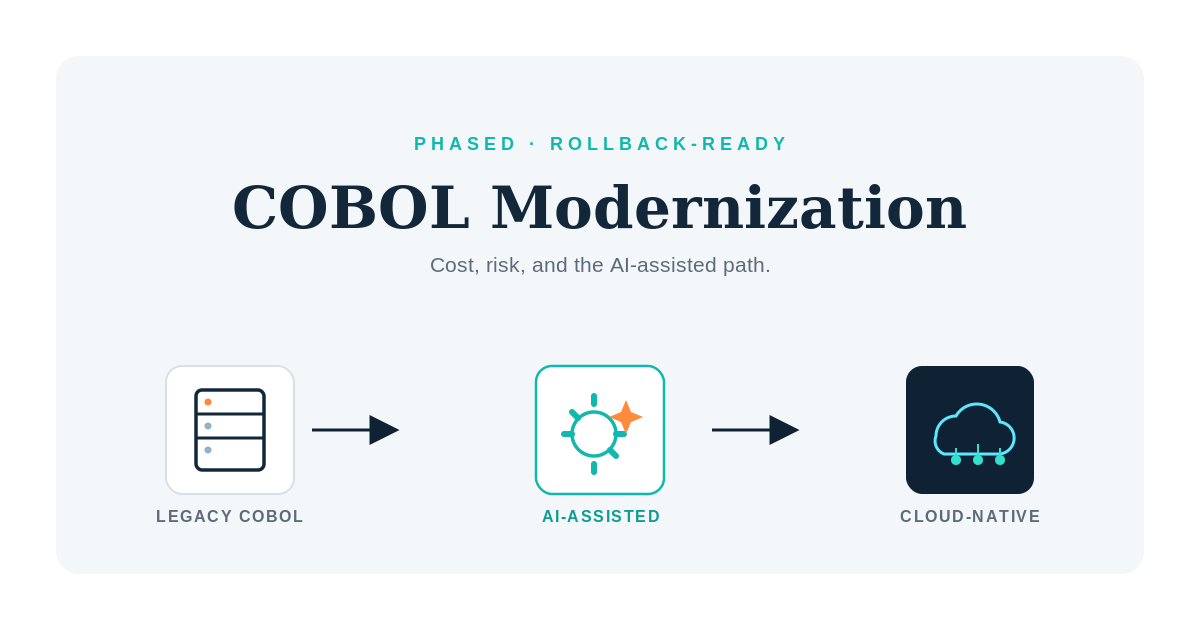
COBOL modernization is the process of moving business logic off aging mainframe COBOL systems onto maintainable, modern architectures — through rehosting, refactoring, rewriting, or replacement. In 2026 the question is rarely whether to modernize. It is how much it will cost, how badly it can go wrong, and where AI genuinely helps — as opposed to where it just adds marketing noise. This is a practitioner’s answer to all three.
Start with why the pressure is real. A 1959 language still runs the core of modern finance: figures widely cited from Reuters’ 2017 “COBOL Blues” analysis put roughly 220 billion lines of COBOL in active use, powering about 43% of US banking systems, 95% of ATM transactions, and some $3 trillion of daily commerce. Those numbers are nearly a decade old and still quoted because little underneath has changed. What has changed is the workforce: the engineers who understand that code are retiring, and the institutional knowledge is leaving with them. That is the actual driver behind most 2026 modernization mandates — not fashion, but risk.
What actually drives COBOL modernization cost
There is no honest flat price for COBOL modernization, and any vendor who quotes one before seeing your estimate is guessing. Cost is set by a handful of drivers, and understanding them is how you build a defensible number:
- Volume and complexity of business logic. Lines of code matter, but tangled, undocumented business rules matter more. A million lines of clean batch processing is cheaper to move than a hundred thousand lines of decades-old exceptions nobody remembers writing.
- Data. Schema migration, data cleansing, and reconciliation are frequently underestimated and frequently where projects overrun. The data layer often costs more than the code.
- Integrations. Every downstream system that reads from or writes to the mainframe is a dependency you must preserve or re-point.
- Target architecture. Moving to a like-for-like rehost is cheaper than re-architecting into cloud-native microservices — but buys you less.
- Approach. The single biggest lever, covered next.
Note what is missing from that list: a dollar figure. Treat cost as drivers and ratios, size it against your own estimate, and be sceptical of anyone who skips this step.
A simple way to sanity-check a vendor’s estimate is to ask how heavily they weight each driver. As a rough guide from the field:
Cost driverWeight on total costMost often underestimated?Business-logic complexity (not raw LOC)HighYes — tangled rules dominateData migration & reconciliationHighYes — routinely under-scopedTesting & parallel runHighYes — treated as optionalIntegrations / downstream dependenciesMediumSometimesTarget architecture (rehost vs re-architect)Medium–HighNo — usually visibleRaw lines of codeLow–MediumNo — over-weighted
If an estimate leans on line count and treats data and testing as afterthoughts, it is not an estimate — it is optimism. The three “High” rows are where real projects overrun.
Approach versus cost: the four paths
Most COBOL modernization efforts pick from four approaches, and the choice sets both the cost and the payoff (framing per IBM’s modernization guidance):
- Rehost (“lift and shift”). Move the application to cheaper or cloud infrastructure with minimal code change. Fast — often weeks — and lowest immediate cost. But the maintainability problem comes with you; you have changed where the code runs, not the fact that few people can maintain it.
- Refactor. Restructure the source, often converting COBOL to a mainstream language like Java, to cut technical debt. This is the sweet spot when the business logic is sound but the language and the skills shortage are the problem.
- Rewrite / re-architect. Rebuild in a modern stack. Highest payoff — and historically the highest cost and risk.
- Replace. Swap the system for a commercial product where one genuinely fits your process.
In practice, large estates blend these: replatform the stable parts, refactor the code that is hard to maintain, rewrite the handful of systems that need new capability, and retire what nobody uses anymore. The blend is usually cheaper and far less risky than treating the whole estate as one monolithic decision.
Where AI-assisted conversion changes the curve — and where it does not
This is the part of the 2026 conversation most crowded with hype, so be precise. Vendors including IBM (watsonx Code Assistant) and Anthropic report that AI meaningfully compresses two stages of a COBOL-to-Java effort: understanding the source — documenting decades of undocumented logic — and translating it into a modern language. On large codebases those stages historically consumed months. Compressing them is real, and it is the reason AI-assisted conversion is worth serious evaluation.
Here is the part the vendor pages tend to skip. AI compresses understanding and translation. It does not remove verification, behavioural-equivalence testing, and parallel run — the stages where cost and risk actually concentrate. A COBOL program that processes financial transactions must produce identical results after conversion, proven against production data, before you switch the mainframe off. AI can draft the Java; it cannot absolve you of proving the Java behaves exactly like the COBOL it replaced. Teams that treat AI as a shortcut past verification are the ones who end up in the next section.
The honest position: AI-assisted conversion changes the cost curve at the front of the project, not the back. Budget the savings where they are real, and keep funding the testing where they are not.
The same pattern holds one layer down, in the data. In our own migration work, the two hardest parts are rarely the volume. The first is understanding the source structure — how the data is actually organized and tagged — because that is where the real complexity and the real risk live. The second is validation and testing that every record has genuinely made it across, intact and correct. The ETL itself, however large the volume, is comparatively straightforward once the design and testing phases have been done properly. Tools — AI or otherwise — are good at volume. They are no substitute for understanding the structure you are moving and proving you moved it correctly.
Why big-bang rewrites fail — and the phased alternative
The most expensive way to modernize COBOL is to replace an entire system in one cutover event and hope nothing breaks. The failure mode is well documented. In April 2018, TSB Bank attempted a single-event “big-bang” migration of around 5.2 million customers to a new core platform; roughly 1.9 million were locked out of their accounts, and the episode is widely reported to have cost the bank on the order of £330 million. The root cause of failures like this is rarely the technology — it is the decision to reproduce decades of undocumented behaviour and switch it all on at once.
The alternative is phased and rollback-ready. Modernize in increments, each delivering a measurable outcome, each reversible if it misbehaves, with the legacy system live until the replacement is proven. It is slower to start and dramatically cheaper to finish, because you are never betting the whole estate on a single cutover.
This is not theory. When Hakuna Matata modernized GS1 India’s national product-registry platforms — legacy systems with no documentation and no room for downtime — the team started with data migration and data design, then rolled the new platform out to a small subset of customers before scaling to the full base. The result was 70 transactions per second at 3x the previous throughput and a 30% reduction in cloud cost, delivered without a big-bang cutover. GS1 was a legacy monolith rather than a COBOL mainframe, but the sequencing lesson is identical: data first, phased rollout, no single point of catastrophic failure.
The hidden costs teams miss
Three costs are routinely left out of the estimate and routinely blow it up:
- Testing and parallel run. Running old and new in tandem to prove equivalence is not optional for critical systems, and it is not free.
- Data migration. The step most likely to be underestimated, for the reason described earlier: the difficulty is in understanding the source structure and proving the migrated data is correct, not in moving the bytes. Getting every record, field, and value across intact — with an audit trail regulators will accept — is its own discipline. Hakuna Matata’s DB Migration accelerator exists precisely because this step is where cutovers stall; it targets 99.99% data accuracy and 60% faster cutovers with zero-downtime phased migration and full audit logging.
- Knowledge loss. The engineers retiring are the documentation. Capturing what they know before they leave is a cost you pay now or a risk you carry forever.
Building a defensible estimate
Pulling it together, a credible COBOL modernization estimate does four things: it sizes the code by complexity, not just line count; it treats data migration and testing as first-class line items, not afterthoughts; it picks an approach per system rather than one verdict for the whole estate; and it books AI-assisted savings at the front of the project while keeping verification fully funded at the back. Do that, and you have a number you can defend to a board. Skip it, and you have a guess dressed up as a plan.
Modernizing COBOL is not a leap of faith. It is applied engineering — phased, measured, and rollback-ready — and the teams that treat it that way are the ones still standing when the cutover completes.
Ready to scope your COBOL estate? Hakuna Matata runs a modernization review that maps your legacy debt, data architecture, and the lowest-risk sequence to modern architecture — before any code moves. Request a Modernization Review.
